
Table of Contents
ToggleThe bathroom vanity is the anchor of the room, it sets the tone, dictates the style, and influences every other finish decision. Yet most homeowners treat color as an afterthought, defaulting to builder-grade white or whatever matches the floor tile. That’s a missed opportunity. The right vanity color can make a cramped half-bath feel airy, a sterile master bath feel warm, or a dated powder room feel current, all without tearing out plumbing or retiling walls. Whether planning a full gut job or painting an existing cabinet, understanding how vanity color works with lighting, square footage, and existing finishes is the difference between a cohesive space and a mismatched eyesore.
Key Takeaways
- Bathroom vanity colors are the visual anchor of the room and directly impact how spacious, bright, and cohesive your bathroom feels—making color selection far more important than most homeowners realize.
- Light and pale finishes expand small bathrooms (under 50 sq ft) by reflecting light, while dark colors require strong overhead lighting (75–100 lumens per square foot) to avoid a cave-like effect.
- The most popular bathroom vanity colors in 2026 include classic whites and off-whites, navy blue and jewel tones, and warm natural wood finishes—each working best when paired strategically with walls, countertops, and fixture finishes.
- Test vanity color samples on foam board or scrap wood in your actual bathroom lighting conditions for several days, since colors shift dramatically under morning light, midday sun, and artificial LED lighting.
- Use the 60-30-10 design rule—with walls as 60%, vanity as 30%, and fixtures as 10% accent—to create a balanced, cohesive bathroom that integrates your vanity color choice seamlessly into the overall space.
Why Vanity Color Matters More Than You Think
A vanity typically occupies 3–6 linear feet of wall space and sits at eye level when someone’s at the sink. That makes it the visual focal point, not the shower or toilet. The color choice affects perceived room size, light reflection, and how well the space photographs, important if resale is on the horizon.
Light reflection is the first consideration. White and pale finishes bounce light around small bathrooms (under 50 sq ft), making them feel larger. Dark colors absorb light, which can make a windowless powder room feel cave-like unless there’s strong overhead and task lighting (aim for 75–100 lumens per square foot in bathrooms).
Material compatibility is the second factor. A painted MDF vanity can be any color, but solid wood or plywood construction shows grain and accepts stain differently. If the vanity is oak or maple, a natural finish or wood-tone stain will look richer than paint. If it’s particleboard with a veneer, paint is usually the move.
Resale considerations vary by market. In traditional or suburban markets, neutrals (white, gray, taupe) appeal to the widest buyer pool. In urban or design-forward areas, bold colors like navy or charcoal signal updated taste. If planning to sell within 3–5 years, skew conservative. If staying put for a decade, choose what works for daily life.
Vanity color also influences maintenance visibility. White shows toothpaste splatters and watermarks. Dark finishes show dust and soap film. Mid-tones (gray, taupe, sage) hide everyday grime better, which matters in kids’ or guest bathrooms that don’t get daily wipedowns.
Most Popular Bathroom Vanity Colors for 2026
Classic White and Off-White Vanities
White remains the workhorse for good reason: it’s timeless, pairs with any tile or wall color, and makes small spaces feel open. But not all whites are equal. Bright white (pure white with no undertones) works in modern or coastal bathrooms with lots of natural light. Warm white or ivory has cream or yellow undertones that suit traditional or farmhouse styles and balance cooler tile finishes like subway or marble.
Off-whites, greige (gray-beige), alabaster, or linen, are gaining ground in 2026 because they feel softer than stark white without reading as beige. These work well with brushed gold or matte black hardware and pair cleanly with white or light gray walls. If the vanity is painted, use a semi-gloss or satin finish for moisture resistance: flat paint will trap humidity and show water damage.
White vanities suit nearly any countertop: quartz, granite, butcher block, or laminate. They’re also the easiest to refresh, just swap hardware or add a new mirror to shift the style.
Navy Blue and Deep Jewel Tones
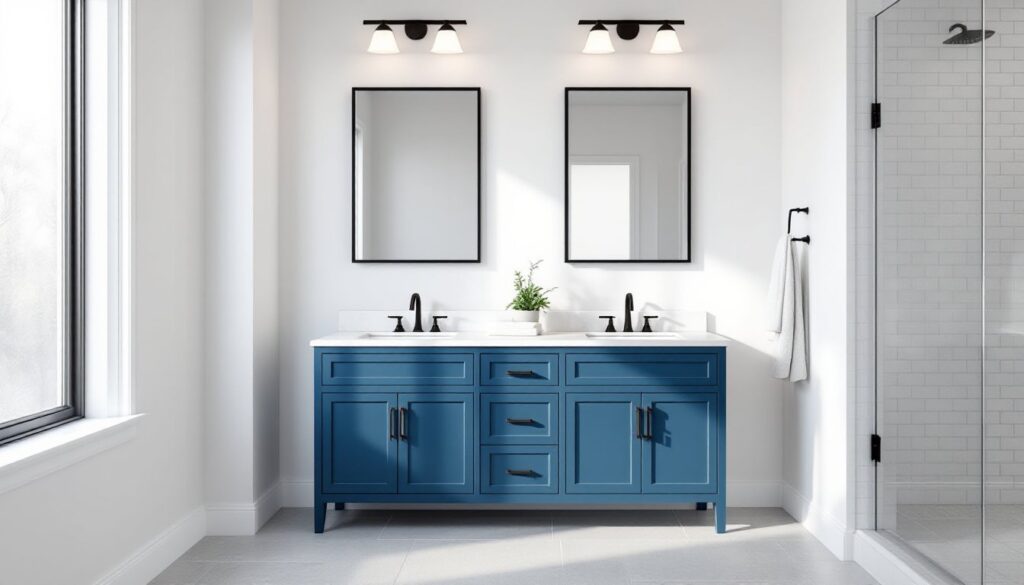
Navy has moved from accent walls to cabinetry, and it’s holding strong in 2026. Navy blue vanities add depth without the harshness of black, and they pair especially well with brass, aged bronze, or unlacquered copper fixtures. In a bathroom with white subway tile and a white or marble countertop, a navy vanity becomes the anchor.
Other jewel tones gaining traction: forest green, charcoal gray, and deep plum. These work best in bathrooms with at least one window or strong artificial lighting (LED recessed cans rated for damp locations, 3000–4000K color temperature). Without enough light, dark vanities can make the room feel claustrophobic.
When choosing bold vanity colors, interior design trends suggest pairing them with lighter walls and countertops to avoid a cave effect. A navy vanity looks sharp against white shiplap, light gray tile, or even a soft blush wall. Avoid pairing dark vanity with dark walls unless the ceiling is high (9+ feet) and there’s generous lighting.
If painting an existing vanity, prep is critical. Sand to 220-grit, prime with a bonding primer like Zinsser B-I-N or Stix, then apply two coats of a moisture-resistant cabinet paint. Skipping primer on a bold color will result in uneven coverage and early chipping.
Natural Wood Finishes and Warm Neutrals
Wood-tone vanities are resurging as a counter-reaction to years of all-white bathrooms. Natural oak, walnut, and white oak with clear or light stain bring warmth and texture. These work especially well in modern organic, Scandinavian, or Japanese-inspired bathrooms where natural materials (stone, linen, matte ceramics) dominate.
Warm neutrals, taupe, sand, soft beige, and greige, sit between white and wood tones. They’re forgiving on water spots, pair well with most tile and paint colors, and feel current without being trendy. A taupe vanity with a white quartz countertop and matte black faucet hits a sweet spot: contemporary but not cold.
When selecting a wood finish, consider the rest of the home’s woodwork. If trim and doors are painted white, a natural wood vanity provides contrast. If there’s wood flooring or exposed beams, try to match the species or tone (cool vs. warm) for cohesion.
For DIYers refinishing an existing wood vanity, use a gel stain for better control and less drip, especially on vertical surfaces. Apply with a foam brush, wipe excess with a clean rag, and let cure 72 hours before sealing with a water-based polyurethane (three coats, sanding lightly between with 320-grit).
How to Choose the Right Vanity Color for Your Bathroom
Start with the fixed finishes: tile, flooring, and any built-in features that won’t change. If the bathroom has busy patterned tile, a solid neutral vanity (white, gray, taupe) keeps things calm. If tile is plain white or gray, a colorful or wood-tone vanity adds interest.
Room size and natural light guide the color range. Bathrooms under 40 square feet benefit from light or mid-tone vanities that don’t shrink the space visually. Larger bathrooms (80+ sq ft) can handle dark or saturated colors without feeling cramped. If there’s no window, stick with colors that have decent light reflectance value (LRV), above 50 for small bathrooms, 30–50 for medium, below 30 only if lighting is robust.
Personal style matters, but should align with the home’s overall aesthetic. A sleek floating vanity in matte charcoal fits a modern home but looks out of place in a 1920s Craftsman with original tilework. When in doubt, choose a vanity color that could transition between styles with a hardware or mirror swap.
How to choose bathroom vanity color also involves testing samples. Paint a foam board or piece of scrap plywood with the candidate color and prop it against the wall for a few days. Check it in morning light, midday, and under artificial lighting at night. Colors shift dramatically depending on the light source, what looks like soft gray at noon can read blue-green under LED bulbs.
Existing or planned countertop also constrains color. White quartz or marble pairs with anything. Dark granite or soapstone looks best with lighter vanity colors for contrast. Butcher block or wood counters pair naturally with painted vanities (white, navy, sage) but can look mismatched with other wood-tone vanities unless the species and finish match closely.
Finally, consider longevity and flexibility. Bold colors make a statement but may feel dated in 5–7 years. Neutrals age gracefully and adapt to evolving decor. If commitment is an issue, paint is reversible, a future owner (or future you) can repaint. Stained wood is harder to change without stripping and refinishing.
Color Combinations That Work: Pairing Your Vanity with Walls and Fixtures
The vanity, wall color, and fixture finish form a visual triangle. When all three harmonize, the space feels intentional. When they clash, it reads as a piecemeal remodel.
White or off-white vanity works with almost any wall color: soft gray, pale blue, greige, even bold navy or charcoal if the room is large enough. Pair with chrome, brushed nickel, or matte black fixtures. Avoid mixing metals unless there’s a deliberate design reason (e.g., aged brass mirror frame with matte black faucet).
Navy or dark vanity looks sharpest against white or light neutral walls. A navy vanity with white subway tile, white walls, and brass fixtures is a proven combination. If going darker on walls (charcoal or deep green), ensure the vanity and walls aren’t the exact same tone, contrast by at least two shades.
Wood-tone or warm neutral vanity pairs well with white, cream, soft sage, or warm gray walls. Bathroom vanity paint ideas often include matte black or oil-rubbed bronze fixtures for a modern organic look, or brushed gold for a warmer, more traditional feel. Avoid cool-toned grays or blues with warm wood, they fight each other visually.
When selecting paint, exploring bathroom inspiration can reveal real-world color pairings. Seeing finishes together in photos beats guessing from swatches.
Countertop and backsplash also influence pairing. A white vanity with black or dark gray countertop creates high contrast, balance it with lighter walls and warm metal fixtures. A wood vanity with light stone countertop pairs with nearly any wall color but looks especially good with soft neutrals or muted greens.
Floor color shouldn’t be ignored. If the floor is dark (charcoal tile, dark LVP), a light vanity keeps the room from feeling bottom-heavy. If the floor is light (white hex tile, light oak), a darker vanity provides grounding.
Fixture finish acts as the accent. Matte black works with any vanity color and adds modern edge. Brushed nickel or chrome feels clean and transitional. Brass or gold (brushed, satin, or aged) warms up white, navy, or wood vanities. Avoid mixing warm (gold, brass, bronze) and cool (chrome, nickel) metals in the same bathroom unless there’s a designer-level reason.
When planning a bathroom makeover, color sequencing matters: choose the vanity color first, then select wall paint and fixtures to complement it. Reversing that order often leads to a vanity that doesn’t quite fit.
For a cohesive look, use the 60-30-10 rule: 60% dominant color (walls or tile), 30% secondary color (vanity), 10% accent (fixtures, hardware, accessories). This prevents any single element from overwhelming the space and ensures customizable bathroom furniture choices integrate smoothly into the overall design.
Testing is non-negotiable. Paint sample boards, bring home finish samples, and view them in the actual bathroom lighting before committing. Colors on a screen or in a big-box store look different under your bathroom’s LED recessed lights or natural window light. The extra hour spent testing saves the cost and hassle of repainting or returning a vanity that doesn’t work.