
Table of Contents
ToggleOnce the holiday decor comes down, that fireplace mantel can look pretty bare. But winter doesn’t end when Christmas does, and your mantel shouldn’t either. A well-styled winter mantel decor setup anchors your living space, draws the eye, and makes those cold months feel intentional instead of just… empty. Whether you’re dealing with a traditional brick surround or a modern shiplap frame, the mantel offers prime real estate for seasonal displays that balance function and style. This guide walks through the essentials of winter fireplace decor, covering materials, layering techniques, lighting, and practical tips to keep your mantel looking polished without spending a fortune or making rookie mistakes.
Key Takeaways
- Winter mantel decor transforms your fireplace into a focal point during the cold months by layering texture, natural materials, and lighting to create warmth and visual interest without a full room redesign.
- Layer different textures at varying heights using birch logs, pinecones, branches, and greenery while sticking to a neutral palette of whites, grays, and muted tones to avoid a flat appearance.
- Warm white LED string lights and battery-operated candles are essential for winter mantel displays, as they add both ambiance and height variation while accommodating safety concerns with active fireplaces.
- DIY elements like foraged branches, painted mason jars, frosted pinecones, and wooden bead garlands make winter fireplace decor budget-friendly and allow for seasonal reuse year after year.
- Avoid common mistakes by respecting scale and depth, using balanced asymmetry instead of perfect symmetry, maintaining 4-6 inches clearance from wall decor, and securing top-heavy items with museum putty to prevent accidents.
Why Your Mantel Deserves Special Attention This Winter
The mantel sits at eye level in most rooms, which makes it a natural focal point. Unlike coffee tables or side consoles, it’s vertical real estate that invites layering and depth. In winter, when outdoor color fades and daylight shrinks, the mantel becomes even more important, it’s where you can add warmth, texture, and visual interest without a full room redesign.
From a practical standpoint, winter mantel decor after Christmas fills the gap between holiday takedown (usually early January) and spring refresh (late March or April). That’s roughly three months where your living room needs structure, and a bare mantel reads as unfinished. A thoughtful winter display signals that the space is intentional, not just recovering from the holidays.
Fireplace mantels also frame the hearth, which is often active during winter. If you’re running a wood-burning or gas fireplace, the mantel becomes a working part of your heating setup, so decor needs to be heat-safe and secure. Avoid placing candles, dried florals, or lightweight fabrics directly above an active firebox. Most building codes require a minimum clearance of 6 inches from the firebox opening to combustible materials, but check your local jurisdiction and manufacturer specs. If your mantel is purely decorative (no active fireplace), you have more freedom with materials.
Essential Elements for a Stunning Winter Mantel Display
A successful winter mantel relies on three core components: texture, natural materials, and lighting. These elements work together to create depth and warmth without requiring a complete overhaul every few weeks.
Layering Textures and Natural Materials
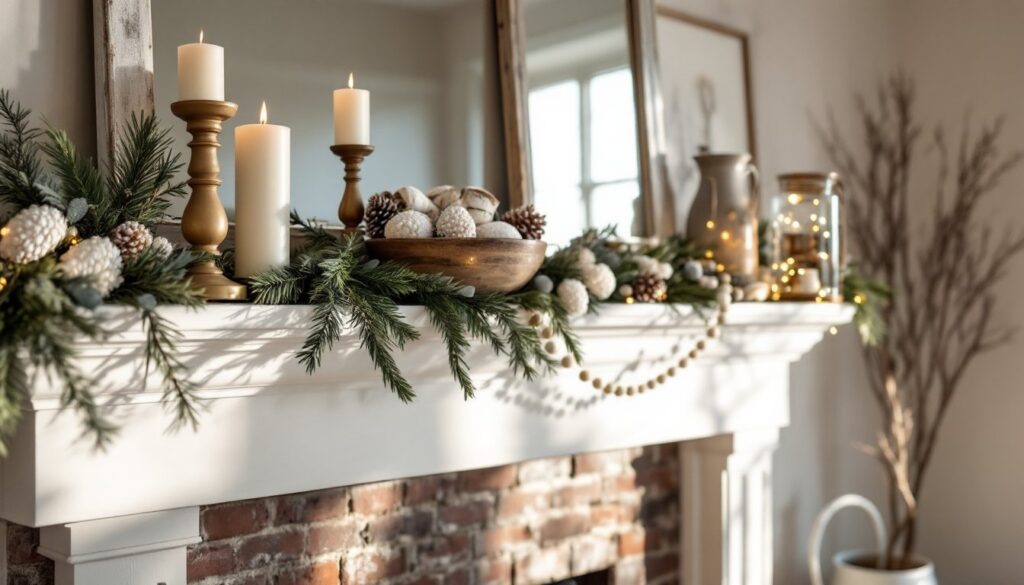
Winter palettes lean neutral, whites, grays, soft browns, and muted greens. To keep that from reading flat, layer different textures at varying heights. Start with a base layer: this could be a garland (fresh or faux), a length of burlap or linen fabric draped along the mantel edge, or even a low-profile tray holding grouped items.
Next, add dimensional elements. Birch logs (real or composite), pinecones, bare branches in tall vases, and frosted greenery all bring organic texture. Real birch logs are available in bundles at most craft stores or home centers: they’re lightweight and won’t damage the mantel surface. If using fresh greenery like eucalyptus or cedar, expect a lifespan of 2-3 weeks indoors before it dries out. Faux options from brands like Hearth & Hand or Terrain hold up better and can be reused season to season.
Incorporate height variation. A flat mantel arrangement looks like a police lineup. Use candlesticks of different heights, stacked vintage books, or a tall lantern on one end. Group items in odd numbers (three candlesticks, five small vases) for a more dynamic composition. Avoid overcrowding, if every inch is covered, the eye has nowhere to rest.
For a rustic winter look with pinecones, consider spray-painting them in matte white or metallic silver for a cohesive finish. Let them dry fully (24 hours in a well-ventilated space) before arranging.
Incorporating Lighting for Warmth and Ambiance
Lighting is non-negotiable in winter mantel decor ideas. Shorter days mean you’re relying on artificial light more often, and the mantel is the perfect spot to layer ambient glow.
Battery-operated LED string lights are the easiest option. Look for warm white (2700K-3000K color temperature) rather than cool white, it reads cozier. Tuck them into garland, drape them along the back edge of the mantel, or coil them inside glass hurricane lanterns. Most battery packs are compact enough to hide behind a vase or book stack.
Candles add both light and vertical interest. Use unscented pillar candles if you’re running the fireplace, competing scents can be overwhelming. Candlesticks in varying heights (8-inch, 12-inch, 16-inch) create a staggered silhouette. If you have small kids or pets, swap real candles for battery-operated flameless versions with timers. Modern LED candles use real wax exteriors and flicker realistically.
If your mantel sits below a mirror or large art piece, consider adding picture lights or small sconces on either side. This isn’t just decorative, proper lighting highlights the artwork and makes the whole vignette feel finished. Hardwired sconces require an electrician (and possibly a permit if you’re adding new circuits), but plug-in picture lights are an easy DIY install using adhesive cable clips along the wall.
Budget-Friendly DIY Winter Mantel Ideas
You don’t need to drop $200 at a home decor store to style a winter mantel. Most effective displays use a mix of DIY projects, natural finds, and a few strategic purchases.
Foraged branches and greenery: If you live near wooded areas, collect fallen branches, pinecones, and evergreen clippings. Birch, willow, and manzanita branches all look sculptural in tall vases. Just shake out any loose bark or insects before bringing them indoors. For longevity, soak fresh-cut greenery stems in water overnight before arranging.
Painted mason jars or thrift store finds: Hit up a thrift store for mismatched candlesticks, glass vases, or ceramic pitchers. A coat of chalk paint (no primer needed, adheres to most surfaces) in matte white or gray unifies the look. Let dry for 24 hours, then seal with a matte polyurethane if the item will be handled often. One quart of chalk paint covers roughly 150 square feet, so a single can goes a long way for small decor projects.
DIY wooden bead garland: Wooden bead garlands have that modern farmhouse vibe and cost pennies to make. Buy unfinished wooden beads (1-inch to 1.5-inch diameter) from a craft store, string them on jute twine, and knot between each bead. For a 6-foot garland, expect to use about 40-50 beads and 8 feet of twine (to account for knots and draping). Drape it along the mantel edge or coil it around a vase.
Frosted pinecone bowl: Gather pinecones, brush them lightly with white craft glue, and dust with Epsom salt or coarse sea salt. The salt crystals mimic frost and catch the light beautifully. Let dry overnight, then pile them in a wooden dough bowl or galvanized tray. Total cost: under $10 if you forage the pinecones yourself.
Printable art or chalkboard signs: If you have a printer and some cardstock, print free winter-themed art or quotes and pop them into thrift store frames. Alternatively, pick up a small chalkboard (8×10 or 11×14) and hand-letter a seasonal phrase using chalk markers. Chalk markers are less messy than traditional chalk and won’t smudge once dry. Lean the frame against the wall or hang it with a small sawtooth hanger.
Many winter mantel ideas for a cozy hearth emphasize natural elements that can be gathered for free, making this a genuinely budget-friendly project category.
Styling Tips to Avoid Common Mantel Decorating Mistakes
Even experienced DIYers make a few predictable mistakes when styling a mantel. Here’s how to sidestep them.
Don’t ignore scale. A common error is using decor that’s too small for the mantel depth. Most mantels are 6-8 inches deep. If you’re placing items only at the front edge, the display looks tentative. Push larger items (vases, lanterns, frames) closer to the wall and layer smaller items in front. This creates depth and uses the full footprint.
Avoid symmetry overkill. Perfect symmetry (matching candlesticks on each end, identical arrangements) can look stiff. Aim for balanced asymmetry: a tall item on one end, a grouping of shorter items on the other, with something anchoring the center. This feels more organic and less like a hotel lobby.
Don’t forget the wall above. The mantel and the wall art or mirror above it should relate to each other. If you have a large horizontal mirror, keep the mantel arrangement lower and wider. If you have a tall vertical piece, you can go taller with candlesticks or branches. Leave at least 4-6 inches of clearance between the top of your tallest mantel item and the bottom of the wall decor so they don’t compete.
Watch your color palette. Stick to 2-3 main colors plus neutrals. Winter palettes typically pair whites and creams with one or two accent tones, soft blue, sage green, charcoal gray, or warm metallics like brass or copper. Adding too many colors fragments the look. If you’re styling winter fireplace decor that transitions easily from post-holiday to early spring, neutrals with natural wood tones offer the most flexibility.
Secure top-heavy items. If you’re stacking books or using tall candlesticks, make sure they’re stable. A bump from a pet or a draft from the fireplace can send things toppling. Use museum putty (a removable adhesive) on the base of candlesticks or vases to anchor them without damaging the mantel surface. It’s reusable and won’t leave residue on painted or sealed wood.
Don’t block the TV (if applicable). If your TV is mounted above the mantel, keep decor low and to the sides so it doesn’t obstruct the screen or look cluttered during use. This is a tough layout to work with, but it’s doable, focus on horizontal arrangements and avoid tall vertical elements in the center.
Conclusion
A well-executed winter mantel doesn’t require a designer budget or a degree in interior styling, it just needs texture, intentional layering, and a few quality light sources. Stick to natural materials, keep your palette tight, and don’t be afraid to move things around until the balance feels right. Your fireplace mantel is prime real estate: treat it like the focal point it is, and the rest of the room will follow.